Richards Bay coal price steadies near $105 a tonne as market avoids a repeat of 2022's spike
A daily price update in early August showed thermal coal holding well below crisis-era highs despite geopolitical risk
The benchmark API4 Richards Bay thermal coal price stood at $105.75 a tonne on 7 August 2026, according to a daily market update, holding in a range that had persisted for much of the year. The level compares with an extraordinary spike to roughly $400 a tonne in 2022, when Russia's invasion of Ukraine disrupted European gas and coal supply chains and sent buyers scrambling for alternative cargoes, including South African coal.
Unlike gold, platinum and copper, all of which saw dramatic price swings through 2025 and 2026, thermal coal's price stayed comparatively stable, reflecting a market that had largely normalised after the 2022 shock, with Asian demand, chiefly from India, providing a steady rather than surging source of buying interest.
Stability with a cost
For South African coal exporters, price stability at a level roughly a quarter of the 2022 peak meant that logistics, not price, had become the dominant variable determining profitability and export volumes. Producers who had enjoyed exceptional margins during the 2022 spike faced a return to more conventional economics, in which the difference between a good and a poor year rested chiefly on Transnet's ability to move coal reliably from mine to port rather than on any windfall from global energy markets.
A market not chasing headlines
The steadiness of the price through periods of renewed Middle East tension, tariff uncertainty and swings in other commodities suggested that thermal coal, unlike the metals dominating 2026's market narrative, was trading on its own fundamentals of supply, freight cost and Asian import demand rather than on the geopolitical risk premium that had periodically driven gold and copper to fresh records over the same months.
Producers said the absence of a price spike, while disappointing for anyone hoping for a repeat of 2022's windfall, at least offered a more predictable planning environment than the extreme volatility then dominating gold, platinum and copper markets over the same months.
Terminal operators said the steadier pricing environment made it easier to plan capital investment in rail and handling infrastructure, since revenue projections no longer had to account for the kind of extreme price swings that had complicated budgeting during the 2022 crisis.
Sources
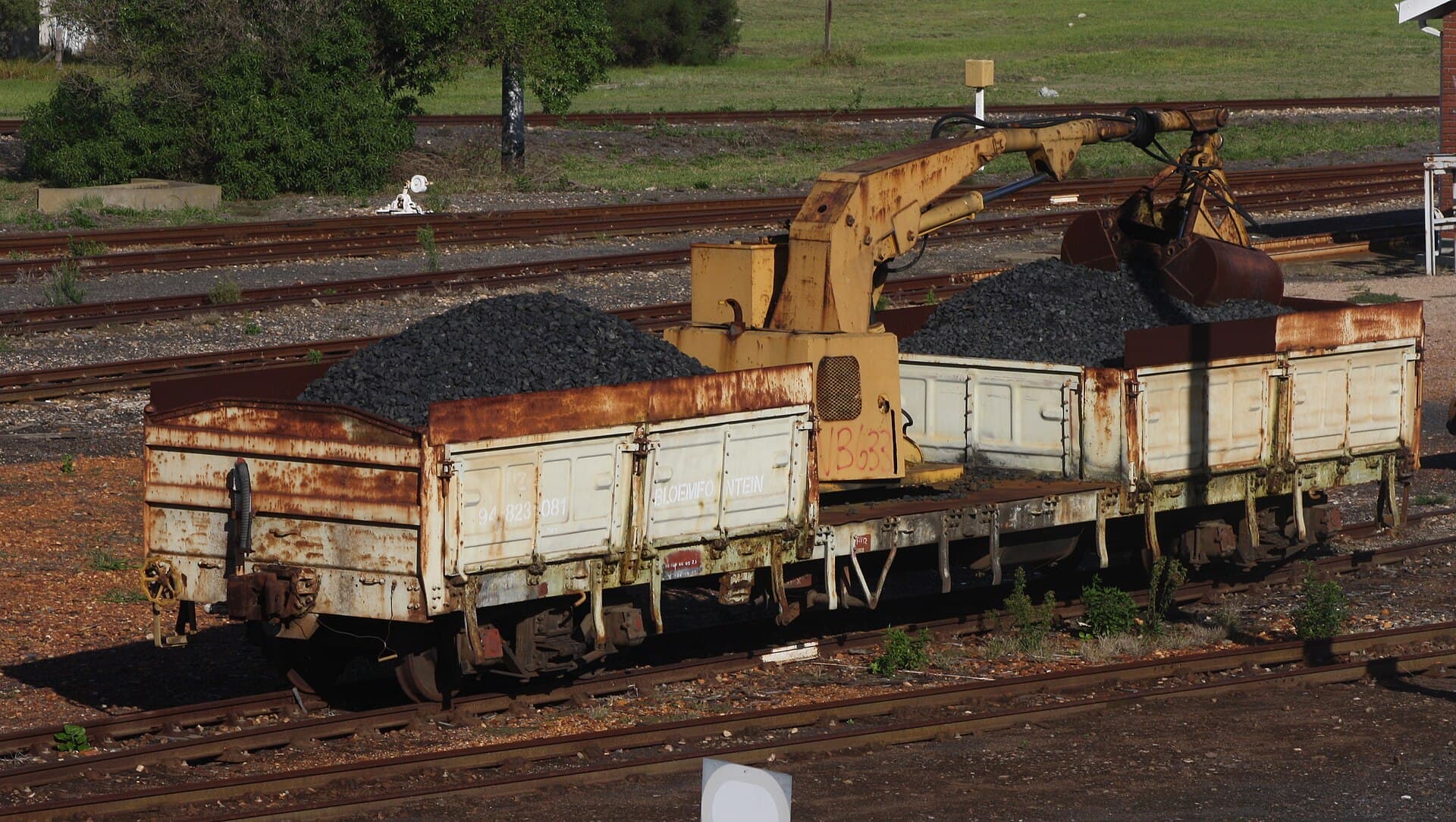
Photo: A Transnet coal wagon in South Africa, part of the rail network that moves coal to the Richards Bay export terminal. Bob Adams from Amanzimtoti, South Africa, Wikimedia Commons, CC BY-SA 2.0.
Was this useful?
More from MiningWrap

The whole sector in one weekly read.
Deals, policy and markets — every Thursday.
Discussion
Loading comments…