Morocco's Managem builds cobalt-sulphate refinery as Bou Azzer output ages
A $100m plant near Marrakech targets 5,000-6,000 tonnes a year of battery-grade material, giving automakers a non-Congolese cobalt source
Morocco's Managem Group is building a cobalt-sulphate refinery near Marrakech, a $100m project designed to produce 5,000 to 6,000 tonnes a year of battery-grade material and turn the country into a credible, if small, alternative to Congolese cobalt.
A century-old deposit, a new downstream ambition
Managem's cobalt story dates back to 1928, when a geologist visiting Marrakech's Jama Lfna square recognised erythrite — a cobalt mineral — in stones for sale, leading to the discovery of the Bou Azzer deposit in the Anti-Atlas mountains. Industrial mining began there in 1934 and has continued, with interruptions, ever since. Today Bou Azzer produces roughly 1,500 tonnes of cobalt a year, placing Morocco among the world's top ten producers even though its output is a fraction of Congo's.
What makes Bou Azzer commercially attractive to Western buyers is not its size but its supply chain: the mine's high-grade feed already underpins direct supply relationships with BMW and Renault, automakers keen to diversify away from Congolese material and the reputational and regulatory questions attached to it. The new Marrakech refinery is intended to extend that appeal by giving Managem its own downstream capacity to turn mined cobalt into battery-grade sulphate, rather than exporting semi-processed material for refining elsewhere.
Why it matters beyond Morocco
Morocco's cobalt output is tiny next to the roughly 220,000 tonnes a year that flows out of the Democratic Republic of Congo. But as Kinshasa's export bans and quotas have made Congolese supply increasingly unpredictable through 2025 and 2026, buyers with the option of a non-Congolese, politically stable source have paid a premium for that certainty. Managem's refinery is a bet that automakers will value traceability and supply security enough to pay for a smaller but more dependable stream of cobalt sulphate.
The project also fits a wider pattern of North African states positioning themselves in battery-metal supply chains even without Congo-scale reserves — competing less on volume than on political and logistical reliability for manufacturers under pressure to diversify.
What happens next
The refinery's start-up, targeted for 2025, will test whether Bou Azzer's ageing underground workings — described by engineers as a labyrinth of narrow stopes with dwindling reserves — can supply enough ore to keep a dedicated sulphate plant running at capacity. Managem has not disclosed a mine-life extension plan alongside the refinery investment, leaving open the question of how long Bou Azzer alone can feed it before the company needs new deposits or third-party feedstock.
Sources
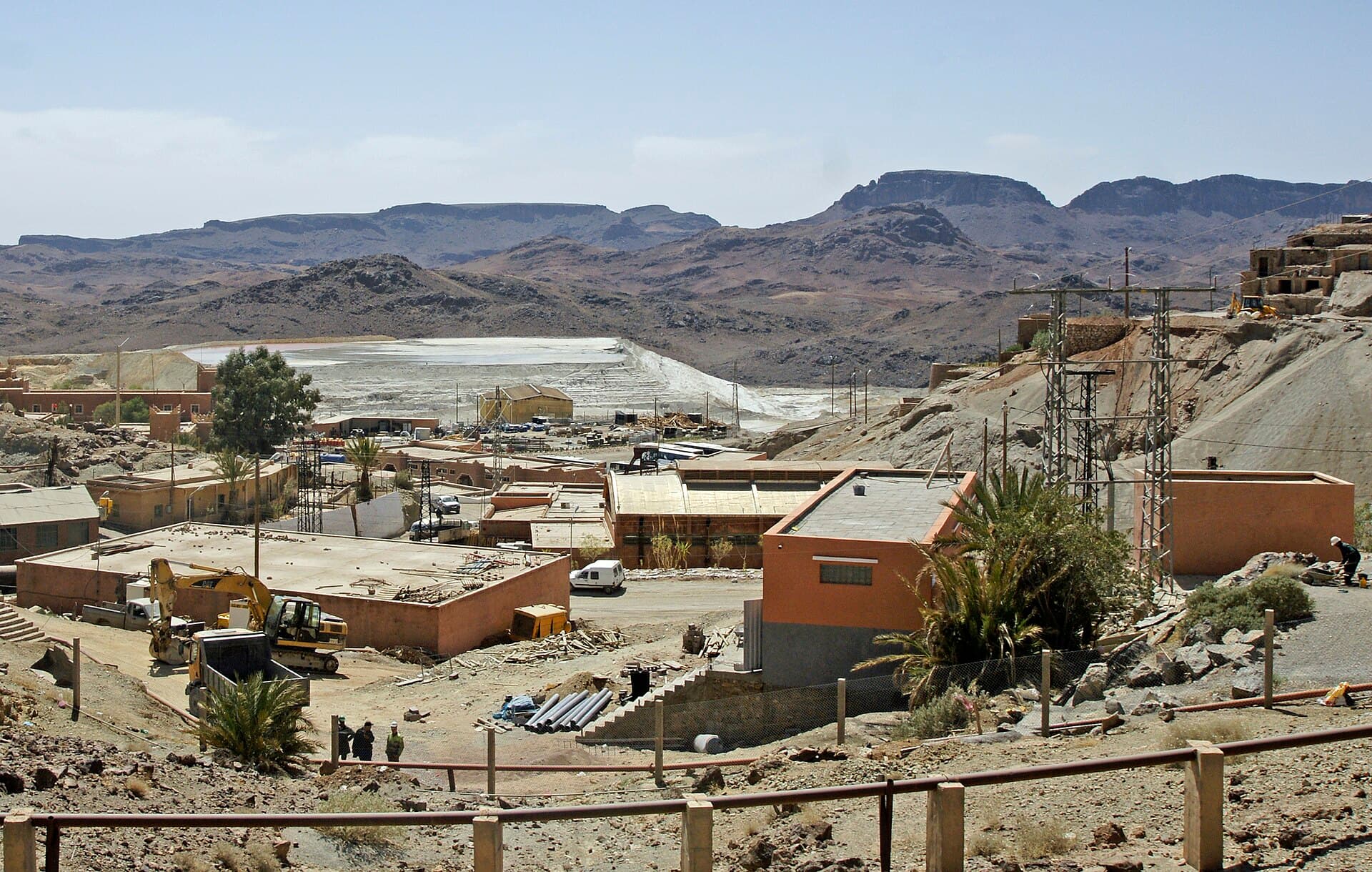
Photo: The Bou Azzer cobalt-nickel-gold mine in Morocco's Anti-Atlas mountains. Mhobl, Wikimedia Commons, CC BY-SA 4.0.
Was this useful?
More from MiningWrap
The whole sector in one weekly read.
Deals, policy and markets — every Thursday.
Discussion
Loading comments…