Diamond slump drags on Namibia's growth outlook
Finance minister flags the sector as a key vulnerability as De Beers cuts output by around 40%
Namibia's finance ministry cut its 2025 economic growth forecast to 4.5%, down from an October projection of 5.4%, pointing squarely at the prolonged downturn in the diamond market as a source of vulnerability for the country's public finances.
Finance minister Ericah Shafudah told parliament that "the continued weaknesses in the diamond sector and the subsequent adverse impact on domestic activities remain a key source of vulnerability," while stressing the need to diversify the economy away from its reliance on a handful of extractive industries.
De Beers pulls back sharply
The warning came as De Beers, 85%-owned by Anglo American and Namibia's dominant diamond producer through Namdeb and Debmarine Namibia, cut rough output by roughly 40% and targeted between 20 million and 23 million carats for the year, well down on historical levels. The group had already taken a writedown of close to R2.9 billion on its diamond business and trimmed prices after the average rough diamond price index fell around 20% over the previous year.
Namibia's marine and land-based diamond operations are a significant contributor to state revenue and foreign exchange earnings, so a sustained pullback in production and price realisations flows directly into the fiscus. The 2026 growth forecast was left only marginally higher, at 4.7%, suggesting officials expect the diamond market to stay subdued for some time rather than snap back quickly.
A structural, not cyclical, problem
Analysts covering the sector have increasingly argued that the diamond downturn is not simply another turn of a familiar boom-and-bust cycle. The rapid rise of lab-grown diamonds, which now undercut natural stones heavily on price, has changed consumer behaviour in key markets such as the United States, while a sluggish Chinese luxury market has removed another traditional pillar of demand. That combination has forced miners across southern Africa, from Debswana in Botswana to Namdeb and Debmarine in Namibia, to cut back production in an attempt to support prices rather than chase volume.
What it means for Windhoek
For a small, diamond-dependent economy like Namibia's, the ministry's language mirrors warnings issued around the same time in Botswana, where diamonds are an even larger share of exports and government revenue. Namibia's government has said it wants to accelerate diversification into other minerals and sectors, but diamonds remain deeply embedded in the country's fiscal base, and further weakness at De Beers' Namibian operations would leave little room for the treasury to manoeuvre in the years ahead.
Sources
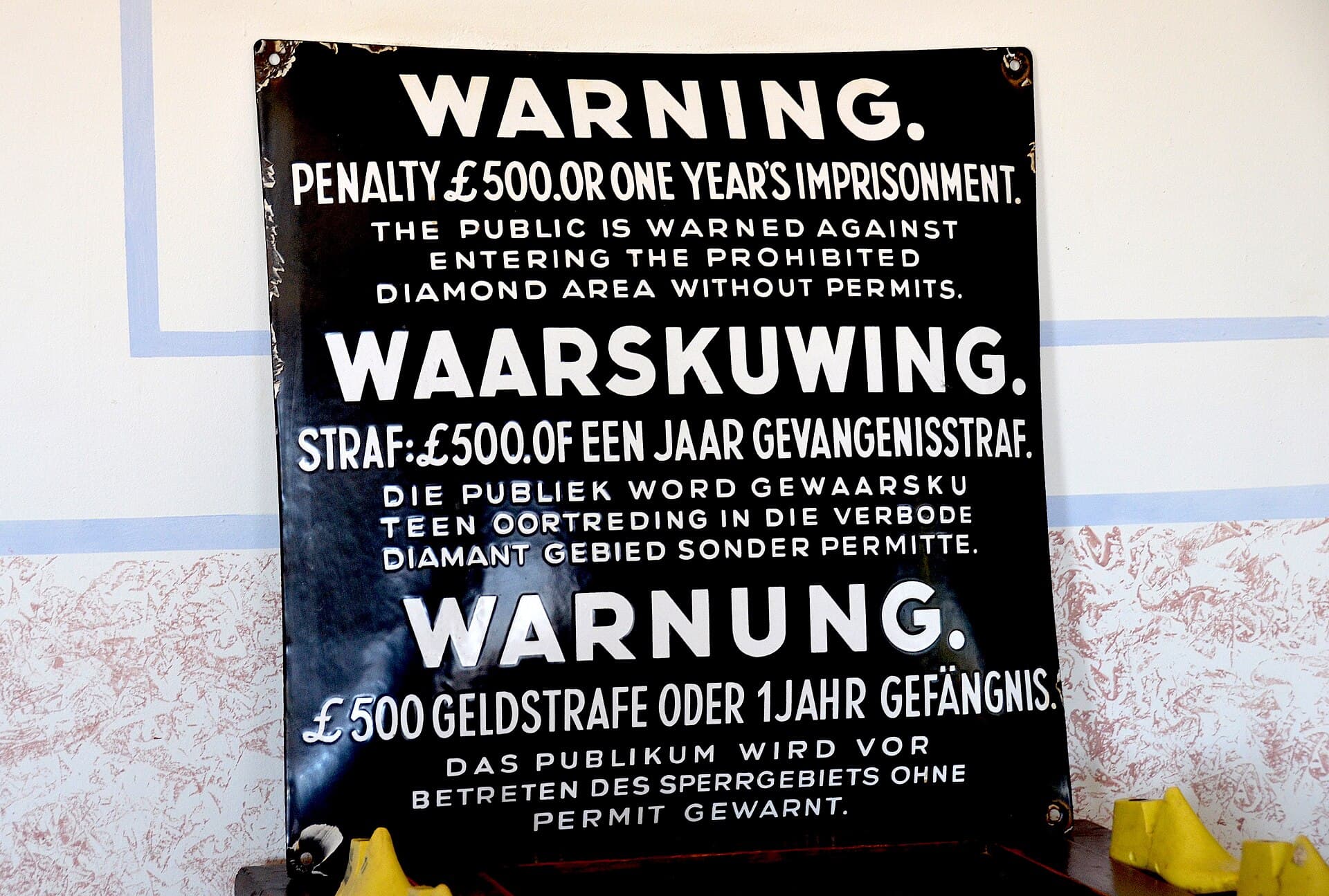
Photo: Warning sign marking a restricted diamond area in Namibia's Sperrgebiet coastal diamond region. Olga Ernst, Wikimedia Commons, CC BY-SA 4.0.
Was this useful?
More from MiningWrap
The whole sector in one weekly read.
Deals, policy and markets — every Thursday.
Discussion
Loading comments…