Transnet's rail reform is real. For miners, it is not yet bankable
Eleven private operators have access agreements and Transnet is back in profit, but the contract terms still leave cargo owners carrying risks they cannot control
About this piece
- Analysis
- Coal, iron ore, manganese, chrome
- 11 September 2026
- 6 min
- transnet, logistics, south africa, coal, iron ore, policy
For the better part of a decade, South Africa's bulk miners have treated freight rail as a problem to be managed rather than a service to be bought. Kumba Iron Ore and Thungela Resources cut production to match what Transnet could carry, and exporters shifted chrome and manganese onto roads that were never built for it. September 2026 brings two pieces of news that, taken together, suggest that era may be ending. Only one of them, though, gives miners something they can plan around.
The first is Transnet's result for the year to 31 March 2026. The group earned R4.6bn after losing R1.9bn the year before, its first annual profit in four years. Revenue grew 7.1% to R88.6bn and rail volumes rose 4.9% to 167.9 million tonnes, according to the government news agency SAnews. The second is structural. The Transnet Rail Infrastructure Manager (TRIM) now has its own chief executive, Moshe Motlohi. It has published a Network Statement, gazetted access tariffs and signed rail access agreements with 11 private train operating companies, Miningmx reported this week.
Both developments are genuine. Neither yet amounts to rail capacity that a mining company, or its lenders, can rely on.
A profit built partly on a sale
Start with the numbers. Transnet sold 49.999% of the Durban Gateway Terminal, formerly Pier 2, to the Philippine port operator ICTSI for R10.5bn, with effect from 1 January 2026. SAnews reported the profit recognised on that disposal, including a fair-value adjustment, at R12.5bn. That one-off gain is larger than the group's entire reported profit. Our reading is that the operating business, before the sale, is still not covering its costs. That matches the other figures: operating expenses rose 10.8% to R57.7bn and the EBITDA margin fell 2.2 percentage points to 34.8%.
That matters for miners because a company still dependent on asset sales and state support has limited room to spend on track, signalling and security. The government extended R149bn in guarantees to Transnet in 2025. Treasury's Budget Facility for Infrastructure has now approved a further R14.8bn in grant funding for rail and port projects. Transnet's capital spending for the year was R23.3bn. On a network that Business for South Africa's transport lead, Ian Bird, estimates is running at only 65% to 70% of nameplate capacity, that is not enough to close the backlog quickly.
The volume story is better than the balance sheet
On the ground, the recovery is clearer in coal than anywhere else. Thungela reported that Transnet Freight Rail moved 56.8Mt on the coal line in 2025, against 51.9Mt in 2024. The North Corridor had reached an annualised rate of 59.9Mt by the time of its interim results in August. Richards Bay Coal Terminal exported 56.5Mt in 2025 and just over 30Mt in the first half of 2026. Its chief executive, Alan Waller, told Miningmx in July that 62Mt for the year was possible if Transnet kept up the 64Mt annualised pace it had run before a planned maintenance shutdown. He credited the full deployment of 102 new locomotives and a security situation back to 2020 levels.
That is real progress, and it came mostly from Transnet repairing its own operation, helped by the National Logistics Crisis Committee. Private operators contributed little to it, because none of them has started running yet. Transnet says the first private services should begin during the 2026/27 financial year.
What the private operators actually add
When Transport Minister Barbara Creecy announced the first round in August 2025, 11 of 25 applicants had qualified for slots on 41 routes. The routes targeted coal, iron ore, chrome, manganese, sugar and fuel. Slot terms were set at one to 10 years. The government said the new entrants would add about 20Mt a year and help reach 250Mt of rail freight by 2029. It also said they could add 10Mt of coal export capacity over three years.
Those numbers need perspective. Bird told Miningmx that Transnet Freight Rail still holds about 180Mt of network capacity. By comparison, new entrants have taken up roughly 22Mt to 24Mt of about 30Mt that was released. Transnet's own figure for last year was 167.9Mt. The gap to the 250Mt goal is therefore about 82Mt, and the private allocations cover less than a third of it. The model adds capacity around the incumbent; it does not replace it. Transnet Freight Rail's performance will still decide whether most mining cargo reaches port.
Some of the new entrants are serious. African Rail Co, one of the 11, told Bizcommunity in May it planned to raise about $170m (R2.8bn) for locomotives and wagons, funded roughly 30% by equity. It intends to run on the Gauteng–Durban line and towards the Mozambique border. It also has regional plans to carry Congolese copper to Maputo. But Traxtion, one of Africa's largest private freight rail companies, stayed out of the first allocation round, and the reasons it gives go to the heart of the problem.
Why lenders are hesitant
Miningmx set out the concerns raised by Bird and by Traxtion chief executive James Holley. Under the current access agreements, a financier cannot easily take security over a rail slot or rely on step-in rights. An operator may still owe access charges when the line is unusable. If a derailment or maintenance failure closes a corridor, the operator faces penalties from its customer, but it cannot recover them from TRIM. Payment obligations do not flex enough for outages or force majeure. A large incumbent can absorb that. A single-slot entrant may not survive it.
This is the crux for mining companies. A mine plan underwritten by lenders needs logistics that can be modelled. A 10-year slot that carries full payment obligations but no enforceable promise that the track will be available is closer to an option on Transnet's performance than a contract. TRIM is also still an operating division of Transnet SOC rather than a separate company. It cannot recover its full costs without pricing rail out of competition with road, so the infrastructure manager and the incumbent operator still share a balance sheet.
What should change, and what miners should do
Two fixes proposed by Bird deserve support from the mining industry. The first is to let cargo owners, not only train operating companies, apply for network slots and then hire an operator. A coal or iron ore producer with a long-life mine and an investment-grade balance sheet is better placed to carry slot risk than a start-up operator with a handful of locomotives. It is also the party with the strongest interest in the corridor working. The second is organised co-funding of maintenance. Bird says Richards Bay coal exporters and iron ore users are willing to pay for identified maintenance packages. These would sit alongside the infrastructure budget facility, the World Bank and private investors.
Both depend on the next Network Statement, which Miningmx reports is already six months late. That document is now the most important piece of logistics policy in South Africa. Industry bodies should push hard for reciprocal penalties, relief from access charges when the line is down, and lender step-in rights. Those terms are routine in rail concessions elsewhere.
Our overall view is cautiously positive. The reform has moved from a white paper to signed contracts, and the coal numbers show that the network can recover when basic maintenance and security are restored. Transnet says it aims to move 61Mt to 65Mt of coal exports in 2026/27. If it reaches that range, it will do more for the coal sector's earnings than any private operator will this year. But the promise of rail reform was that miners would stop depending on a single state operator. That will not happen until a rail slot is something a bank will lend against. On present terms, it is not.
Sources
- Miningmx: Miners doubt if Transnet's rail reform is bankable, 09 Sept 2026
- SAnews: Transnet records profit, 11 Sept 2026
- Engineering News: Transnet returns to profit on asset sale, higher freight volumes, 10 Sept 2026
- Miningmx: SA coal exports could rise 10% in 2026, says terminal, 22 Jul 2026
- Miningmx: Thungela ready to tap extra rail capacity with third-party coal, 17 Aug 2026
- Bizcommunity: SA freight rail opens to private operators, 22 Aug 2025
- Bizcommunity: The R2.8bn private investment unlocking SA's struggling rail logistics sector, 08 May 2026
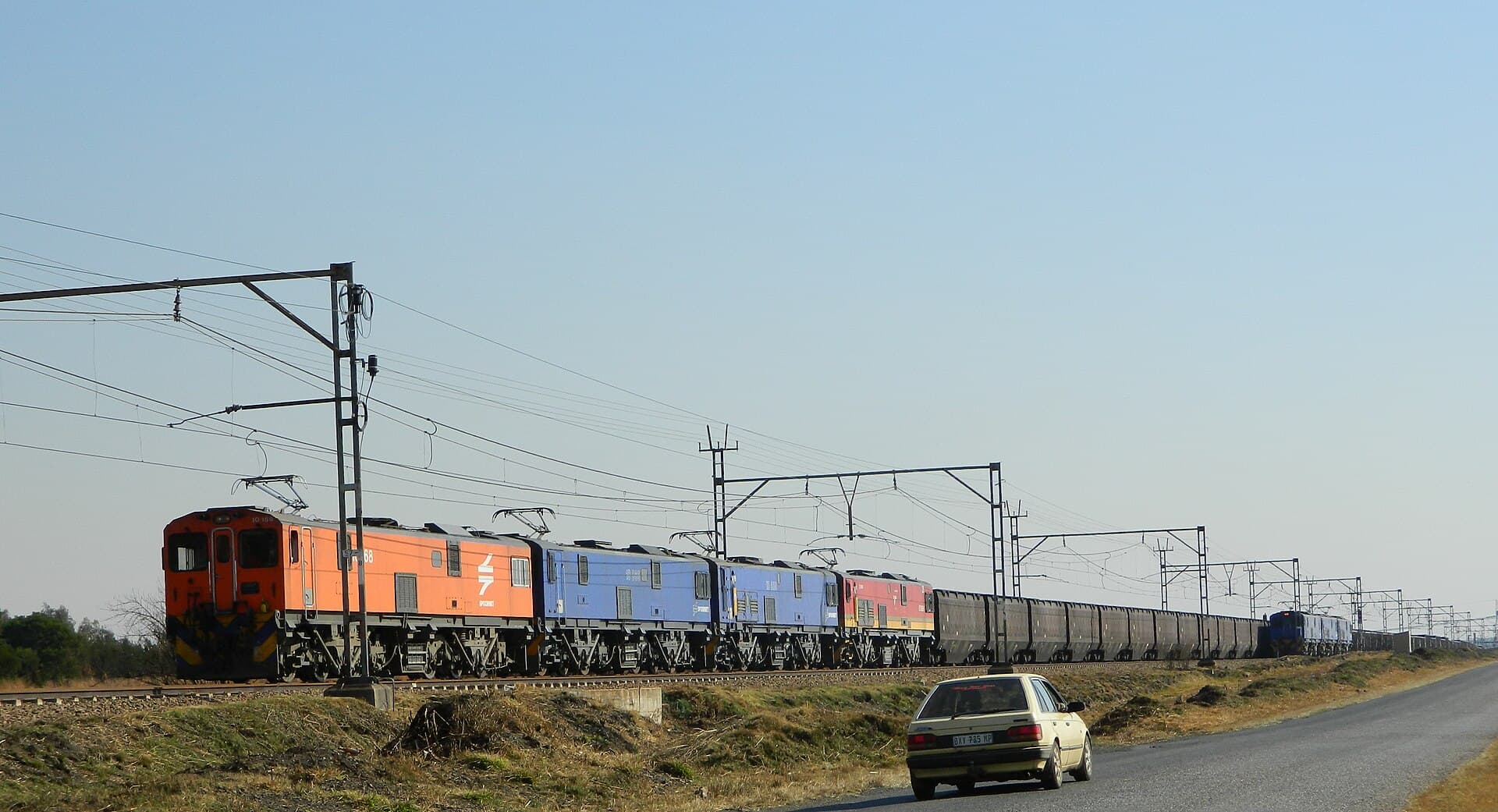
Photo: Two Transnet coal trains made up of empty wagons passing each other at Kendal, Mpumalanga. Bob Adams from Amanzimtoti, South Africa, Wikimedia Commons, CC BY-SA 2.0.
Was this useful?
Discussion
Loading comments…